

NECK PAIN & HEADACHE CARE | LAGUNA NIGUEL
Neck Pain,
Headaches & Migraines

Neck pain, stiffness, recurring headaches, and numbness or tingling into the shoulder, arm or hand can have different causes. We start by understanding what may be contributing to your symptoms through a detailed history, cervical examination and digital X-rays.
We evaluate cervical alignment, movement, posture, disc-space changes, muscular tension and nervous-system function - including possible nerve-root involvement when symptoms travel into the arm or hand.
Your care is individualized to what we find and may include manual, upper-cervical, instrument-assisted or standing postural adjusting—or a combination of approaches.
A CLOSER LOOK AT THE CERVICAL SPINE
A More Complete Cervical Evaluation
Neck pain and headaches can be influenced by more than the area where symptoms are felt. We evaluate how the cervical spine is structured, how it moves, how the head is positioned over the neck, and how the nervous system is functioning to better understand what may be contributing to your symptoms.
Digital X-rays allow us to assess cervical alignment, the natural cervical curve, vertebral and disc-space changes, and degenerative findings. We also evaluate posture, movement and nervous-system function using tools such as surface electromyography (sEMG), thermal scanning and heart-rate variability (HRV).
For patients with headaches or suboccipital pain, we pay particular attention to the upper cervical region—including the relationship between the occiput, atlas (C1) and axis (C2). When symptoms extend into the shoulder, arm or hand, we also assess for signs of possible nerve-root involvement and determine whether additional imaging or medical referral may be appropriate.


INDIVIDUALIZED CERVICAL CARE
Different Necks Need Different Approaches
No single adjusting technique is right for every patient. Your health history, cervical structure, previous injuries, comfort level and examination findings all influence how we approach care.
Depending on what we find, care may include precise manual or upper-cervical adjusting, Activator or ArthroStim instrument-assisted techniques and standing postural adjusting—or a combination of approaches.
We continue to assess how your neck is moving and responding as care progresses, adapting the approach to the individual rather than using the same technique for everyone.
★★★★★
“Jennifer uses an activator technique that has been incredibly effective for me. I’m truly grateful for her care and expertise.”
— Debbie Drew · Google Review
WHEN NECK SYMPTOMS TRAVEL
Neck Pain, Numbness & Tingling Into the Arm or Hand
When a cervical nerve is irritated or compressed, symptoms can extend beyond the neck into the shoulder, arm or hand. Depending on the nerve involved, this may include radiating pain, numbness, tingling or weakness.
The pattern of those symptoms—where they travel, what movements affect them, and whether strength or sensation has changed—can provide important clues about whether the cervical spine may be involved and what the appropriate next step should be.
Not every case of arm or hand numbness begins in the cervical spine. Similar symptoms can sometimes come from the shoulder, elbow, wrist or other peripheral nerves. Part of our job is to look at the entire pattern so care is directed toward the most likely source rather than simply treating where the symptoms are felt.
Tracey Abbott · Patient Experience

OUR ADJUSTING APPROACH
Specific Techniques. Chosen for the Individual.
Dr. Scott Waddell was trained at Palmer College of Chiropractic in traditional
Palmer adjusting methods, with additional postgraduate training in
Gonstead chiropractic biomechanics and Chiropractic BioPhysics (CBP).
Dr. Jennifer Waddell has advanced training in Activator technique. Together, this allows
us to choose from several approaches based on your examination findings,
cervical structure, goals and comfort level.
Gonstead-Specific Adjusting
Dr. Scott’s postgraduate training in the Gonstead Technique emphasizes identifying the specific vertebral segment that is restricted or dysfunctional and delivering a precise adjustment to that segment rather than broadly mobilizing the cervical spine.

Specific Diversified Adjusting

When manual adjusting is appropriate, Dr. Scott uses precise cervical techniques designed to address the involved segment while minimizing unnecessary movement through the surrounding neck.
Activator Technique
Dr. Jennifer uses Activator technique to provide a precise, instrument-assisted adjustment without the rotational movement associated with traditional manual cervical adjusting. This can be an excellent option for patients who prefer a gentler approach.


Postural & CBP-Informed Care
Dr. Scott’s training in Chiropractic BioPhysics (CBP) principles informs a broader structural approach to cervical care, including forward head posture, cervical-curve changes and overall spinal alignment. Corrective strategies may include standing postural adjusting, cervical-extension work and home traction when appropriate.
HEADACHES, THE UPPER NECK & MIGRAINES
_mp4.jpg)
When Head Pain May Involve the Neck
Headaches do not all have the same cause. Certain headache patterns—including tension-type and cervicogenic headaches—may occur along with neck stiffness, restricted movement, muscular tension or pain around the base of the skull.
When headaches are part of the picture, we pay particular attention to the upper cervical region, including the relationship of the occiput, atlas (C1) and axis (C2), along with cervical movement, posture, muscular tension and neurological findings. The goal is to determine whether neck-related factors may be contributing to the individual pattern of symptoms.
Migraine is a neurological disorder and can involve multiple causes and triggers. We do not assume that every migraine originates in the neck. Instead, we evaluate whether cervical or mechanical factors may be contributing and recommend appropriate medical evaluation or co-management when warranted.
“Within a few short weeks, my headaches were nearly gone and I had greater mobility in my neck and shoulders.”
★★★★★
— Marilyn Tamanaha · Google Review
Rachel Barnett · Patient Experience
WHY WADDELL WELLNESS
A More Individualized Approach to Neck Pain & Headaches
Effective care starts with understanding the individual—not applying the same technique to every neck or every headache pattern. At Waddell Wellness & Performance, our approach combines detailed evaluation, multiple adjusting options and ongoing reassessment to help guide care based on what we actually find.
A Detailed Evaluation
We evaluate balance and posture, and use digital X-rays to assess cervical alignment, forward head posture, the degree or percentage of loss of the normal cervical curve, disc-space changes and signs of arthritis. We also assess nervous-system patterns using surface electromyography (sEMG), thermal scanning and heart-rate variability (HRV) to better understand your structural and neurological patterns before recommending care.
Multiple Adjusting Options
We use precise manual and upper-cervical adjusting, ArthroStim instrument-assisted adjusting, Activator technique and standing postural adjusting. The approach is selected based on your findings, goals and comfort level rather than using the same technique for every patient.
Care That Evolves With You
We reassess how your neck is responding and adapt your adjusting approach, exercises, postural recommendations and home care as you progress. Depending on your cervical curve, neurological symptoms and goals, home care may include specific stretches and exercises, a Posture Pump decompression device, or a cervical lordosis fulcrum for home traction.
Experienced, Personal Care
Drs. Scott and Jennifer Waddell provide care personally at our Laguna Niguel office. You are treated by experienced doctors who know your findings, your goals and how your care is progressing. That continuity helps keep your care personal, consistent and responsive as your needs change.
LIMITED-TIME NEW PATIENT SPECIAL
Are You Dealing With Neck Pain, Stiffness, Headaches or Migraines?
Your first visit is designed to help us better understand what may be contributing to your neck
or head symptoms, including cervical structure, movement, posture and neurological function,
and determine the most appropriate next steps for you.
YOUR EVALUATION INCLUDES
✓ Private Doctor Consultation & Health History Review
✓ Comprehensive Spinal & Neurological Evaluation
✓ Digital Spinal X-Rays, When Clinically Appropriate
✓ HRV, Surface EMG & Thermal Nervous-System Scans
✓ Doctor Review of Findings & Personalized Recommendations
Schedule Your
$97 New Patient Evaluation
For a limited time, new patients can schedule this comprehensive introductory evaluation for $97.
The standard fee for the included services is $350.
Choose a convenient appointment time below and our team will confirm your visit.
Or call us directly — (949) 860-2400

Wolff’s Law: Bone Responds to Mechanical Stress
Bone continually remodels in response to mechanical loading—a principle known as Wolff’s Law. When chronic mechanical stresses change, the vertebral bodies and joints can respond through remodeling, sclerosis and osteophyte formation, commonly called bone spurs.
In simpler terms: the spine adapts to the forces placed on it. Over time, some of those adaptations can contribute to degenerative change.
Position Sense, Balance & the Cervical Spine
The neck contains an important proprioceptive system that continually tells the brain where the head is positioned in space. This information works together with the eyes and inner-ear vestibular system to help control posture and balance.
Research has associated cervical disorders and forward-head posture with changes in cervical position sense and certain measures of balance and postural control.
WHY CERVICAL ALIGNMENT MATTERS
Your Neck Can Change Before It Hurts
The absence of neck pain does not necessarily mean the absence of change. Cervical posture, mobility, disc health and joint degeneration can change gradually over years—sometimes long before a person realizes there is a problem. That is one reason our evaluation looks beyond symptoms alone.
A 10–12 Pound Head Changes the Equation
The adult head weighs roughly 10–12 pounds—about the weight of a bowling ball. The normal cervical lordosis, or forward curve of the neck, helps position and distribute that load through the cervical spine.
When the head translates forward or the normal cervical curve becomes significantly reduced, straightened or reversed, the mechanical forces passing through the discs, facet joints and vertebral bodies can change.
In simple terms: a bowling ball is much easier to support close to your body than held out in front of you.
When Degeneration Reduces Space for Nerves
With cervical spondylosis—degenerative change in the neck—discs may lose height while arthritis and osteophytes develop around the vertebral bodies, uncovertebral joints and facet joints.
These changes can contribute to foraminal stenosis, narrowing around an exiting nerve root, or central canal stenosis, narrowing around the spinal cord. Depending on severity, symptoms may include arm pain, numbness, tingling, weakness, balance problems or changes in hand coordination.
The Neck, Headaches & Migraine
Some headaches have a direct cervical source. In cervicogenic headache, pain originating from structures in the upper cervical spine can be referred into the head.
Tension-type headaches can involve several factors, but research has found associations with forward-head posture, reduced cervical movement and muscular tenderness. Migraine is a neurological disorder, yet neck pain and measurable cervical dysfunction are common in a subset of migraine patients.
Upper Cervical Spine & Referred Head or Facial Pain
Sensory information from the upper cervical nerves—particularly C1, C2 and C3—converges with the trigeminal sensory system in an area called the trigeminocervical complex.
Because these pathways overlap, irritation arising from upper-cervical joints, muscles or occipital nerves can sometimes be perceived as pain in other areas of the head or face.
In simpler terms: where pain is felt is not always where the pain originates.
When Neurological Changes Become More Serious
Advanced cervical degeneration can sometimes narrow the spinal canal enough to affect the spinal cord, a condition called degenerative cervical myelopathy.
Possible findings can include worsening balance, difficulty walking, loss of hand coordination, unusual weakness, hyperreflexia or other neurological changes. These findings require appropriate medical evaluation and may require advanced imaging or specialist referral.
© 2026 Waddell Wellness & Performance. Educational content may not be reproduced without permission.
SPINAL HYGIENE & HOME CARE
What You Do Between Visits Matters
Most people were taught from childhood how to care for their teeth, but very few were ever taught how to care for their spine. We believe spinal health deserves the same kind of consistent attention. Based on your examination, posture, X-rays and neurological findings, we may recommend specific daily strategies designed to support mobility, posture, strength and long-term cervical function.
Five Minutes of Daily Spinal Mobility
We teach a simple daily spinal-hygiene routine using controlled movement through rotation, lateral flexion and flexion-extension, often while sitting on a stability disc.
About five minutes of comfortable daily movement helps warm the spinal muscles, maintain mobility and support the normal fluid movement and nutrient exchange that occurs through movement of the spinal discs.
Move your spine every day—not just when it hurts.


Retrain Forward Head Posture
When the head has translated forward, we may prescribe exercises designed to bring the head back over the shoulders and improve the relationship between the head, neck and upper back.
Depending on the patient’s posture and cervical-curve findings, this may include negative-Z exercises and controlled cervical extension using a towel, resistance band or cervical exercise device.
Better posture is trained—not simply held.
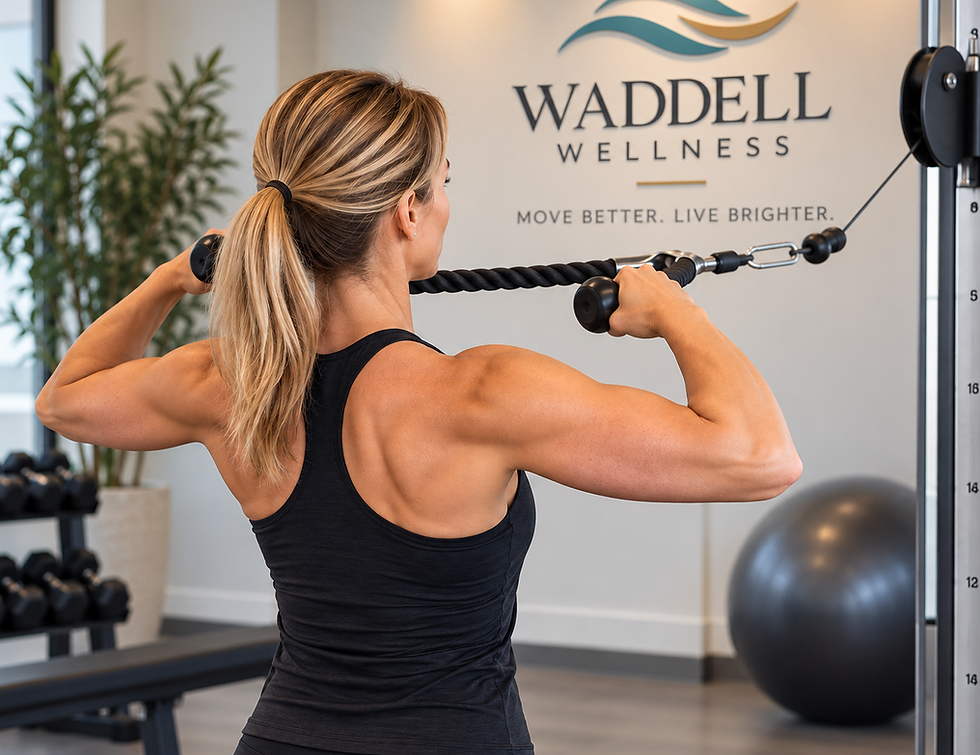
Open the Chest & Strengthen the Postural Muscles
Long hours at computers and phones can encourage rounded shoulders, increased upper-back flexion and tightness through the chest.
Depending on the individual, we may recommend thoracic extension over a foam roller, stability ball or similar support, along with pectoral stretching, wall angels and face pulls to strengthen the muscles that help support better upright posture.
Strong posture requires both mobility and strength.
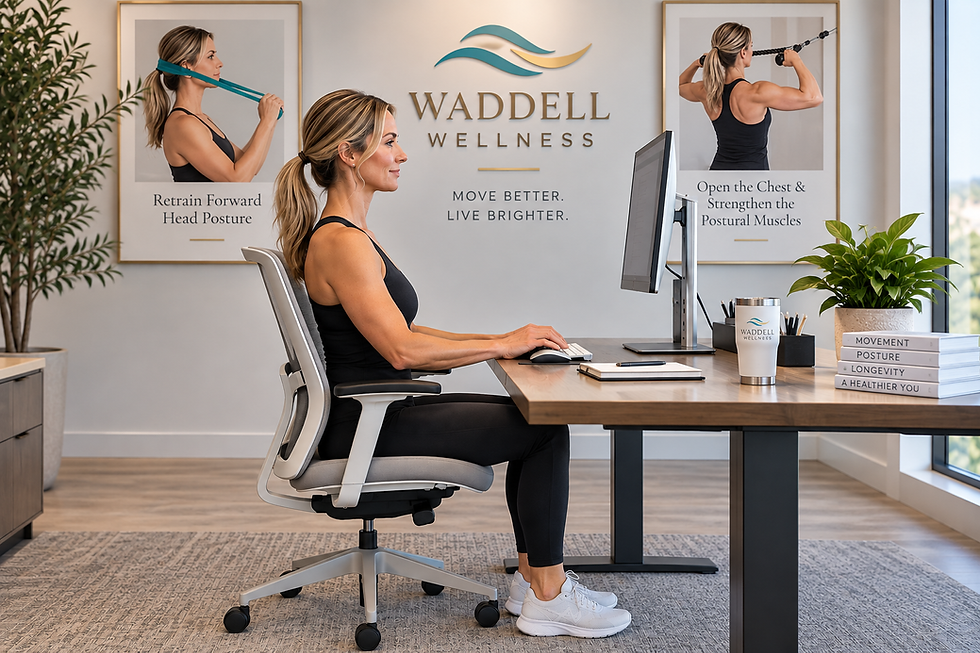
Build Better Ergonomics Into the Day
Good neck posture often starts lower in the spine. When the pelvis and low back collapse into a slouched position, the upper back rounds and the head commonly shifts forward.
We encourage a neutral sitting position with good lumbar support, feet and knees comfortably aligned, and the center of the computer screen near eye level. For phones, bring the device up toward eye level rather than repeatedly bending the neck downward.
We also recommend getting up and moving for about five minutes every 30 minutes during prolonged sitting or computer work.
Change the environment so better posture becomes easier.
Curve-Specific
Cervical Home Care
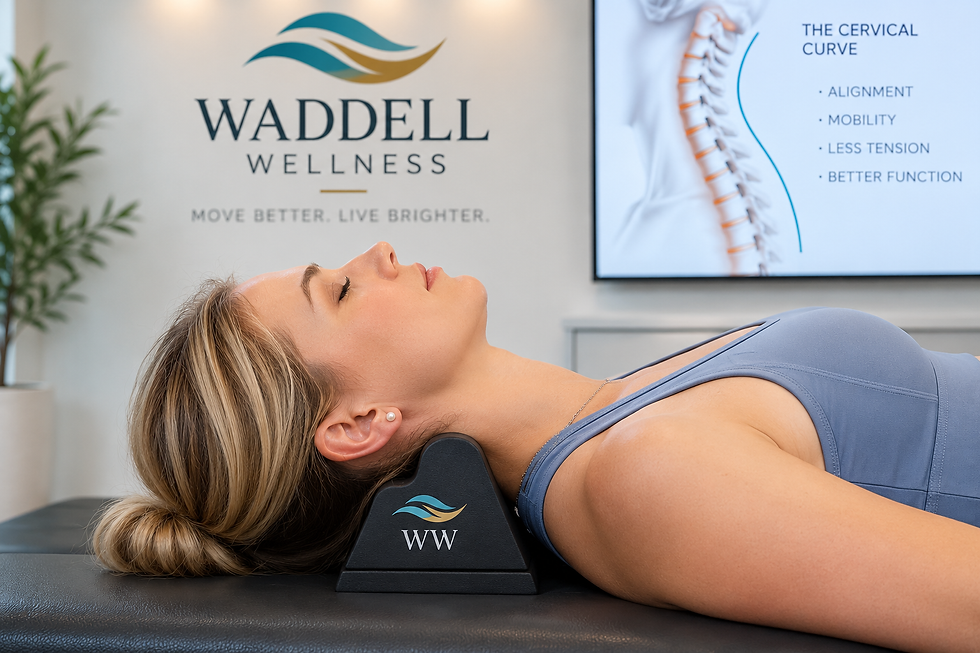
When X-rays show significant straightening or reversal of the normal cervical curve, we may prescribe a cervical lordosis fulcrum or extension-traction strategy as part of the patient’s home care.
Placement is determined from the individual patient’s X-rays, based on where the curve has been reduced or reversed. Duration and intensity are then progressed gradually according to the patient’s tolerance, findings and response.
Curve correction should be individualized—not guessed.

Decompression & Traction When Appropriate
For selected patients with cervical disc-space loss or degenerative changes, we may recommend home decompression using a Posture Pump Dual Disc Hydrator, Model 1400-D, or another cervical traction approach.
These tools are not appropriate for every neck problem. When numbness, tingling, weakness or nerve-root irritation is present, the direction and type of traction must be chosen carefully because certain positions can aggravate symptoms in some patients.
If neurological findings are significant or progressive, we may recommend advanced imaging such as MRI and appropriate specialist referral before proceeding with home traction.
Decompression should match the diagnosis—not just the symptom.
Spinal Hygiene for Life
Our goal is not to make caring for your spine something that only happens in the office. We teach you individualized mobility, postural exercises, ergonomic strategies and home traction techniques that can become part of your regular routine outside of visits.
Over time, these habits can become part of lifelong spinal hygiene—helping you care for your spine today and into your 70s, 80s and beyond, so your spine can continue to support the way you want to move, work and live.
Learn it here. Use it at home. Carry it with you for life.
WHEN REFERRAL IS WARRANTED
When Medical Evaluation
Should Come First
Most neck pain and recurring headaches are not medical emergencies. But certain symptoms and neurological findings deserve medical evaluation before beginning cervical treatment.
Seek Urgent or Emergency Medical Care For
- A sudden, explosive or “worst headache of your life”
- A new severe headache with confusion or fainting
- New difficulty speaking or significant vision changes
- Sudden weakness or numbness
- Fever with a severe headache and stiff neck
- Significant head or neck trauma with neurological symptoms
Findings That May Need Further Evaluation
- Progressive arm or hand weakness
- Persistent or worsening numbness or tingling
- Loss or significant change in reflexes
- Increasing difficulty with balance or walking
- Loss of hand coordination
- Other significant or progressive neurological changes
How We Handle This at Waddell Wellness
Our evaluation is designed not only to determine what we may be able to help, but also to recognize when something requires a different level of care. If your history or examination raises concern, we may recommend MRI or other advanced imaging, consultation with your primary-care physician, neurologist or orthopedic specialist, or urgent or emergency evaluation when appropriate.
Knowing when not to adjust the cervical spine is part of a responsible chiropractic evaluation.
NECK PAIN & HEADACHE FAQ